

Ketamine Integration Therapy in New York
Ketamine opens the door. Integration is what walks you through it.
For people doing ketamine therapy who want more than a 30-minute follow-up call. For people who had a powerful session months ago and watched the openings fade. For people considering KAP who want to make sure the work actually lands before they begin.
NY-LICENSED LMHC · DIAGNOSTIC PRIVILEGE · NYU-TRAINED · OUT-OF-NETWORK SUPERBILLS
THE MEDICINE ISN'T THE WORK
Ketamine creates a window — a state of openness, neuroplasticity, and access to material that's usually out of reach. For 24 to 72 hours after a session, the brain is genuinely different: defenses soften, patterns become visible, change is biologically possible.
That window closes. What gets left behind depends almost entirely on what happens next.
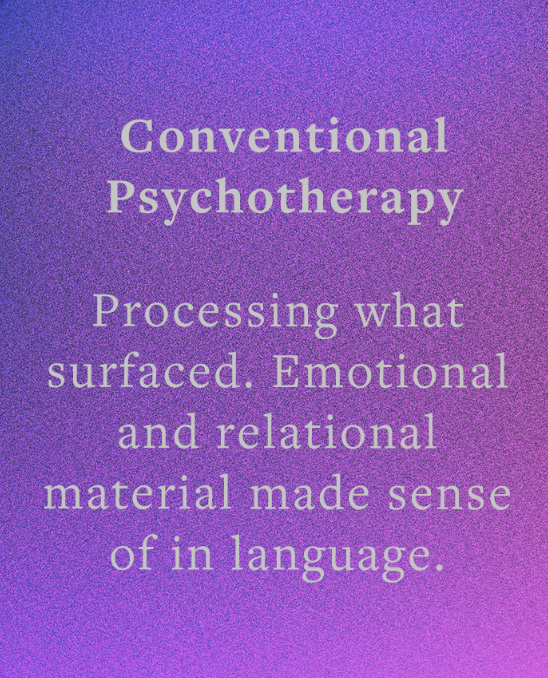
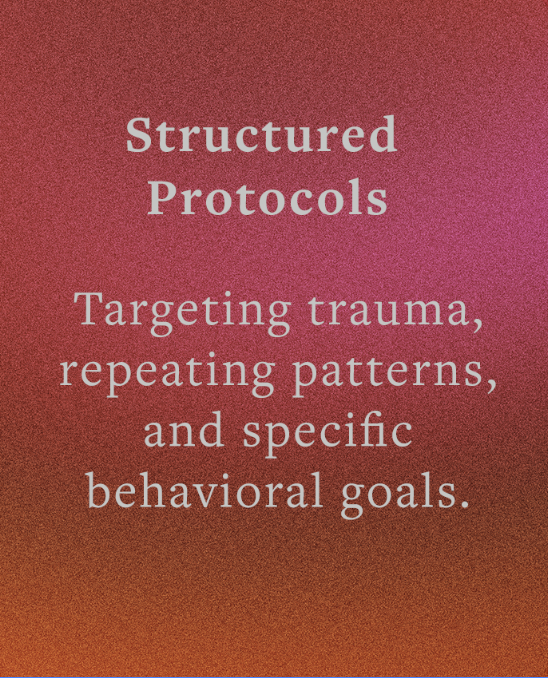
Most ketamine patients are told to journal about it and given a brief check-in. That's a start, not a strategy. Real integration is structured therapeutic work, with a clinician trained in the modalities that turn altered-state insight into durable nervous-system change.
This is that work.

Why This Practice Exists
Integration support in New York is structured a few ways: at the ketamine clinic itself, where time is necessarily brief and protocols are designed to serve many patients; with unlicensed coaches and integration specialists, who can't legally diagnose, treat clinical conditions, or provide superbills; or with generalist therapists who haven't worked with the medicine before.
This practice is built on a different combination: a New York–licensed Mental Health Counselor with formal hypnotherapy training, eight years in clinical practice, and direct experience working with patients in active or post-ketamine treatment.
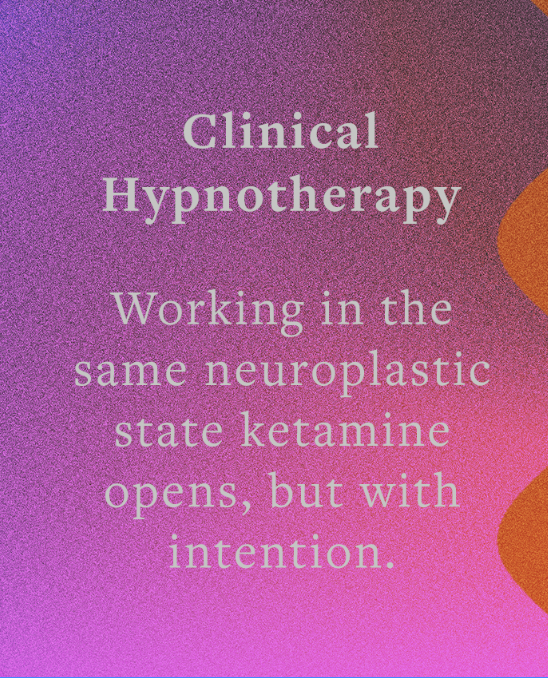
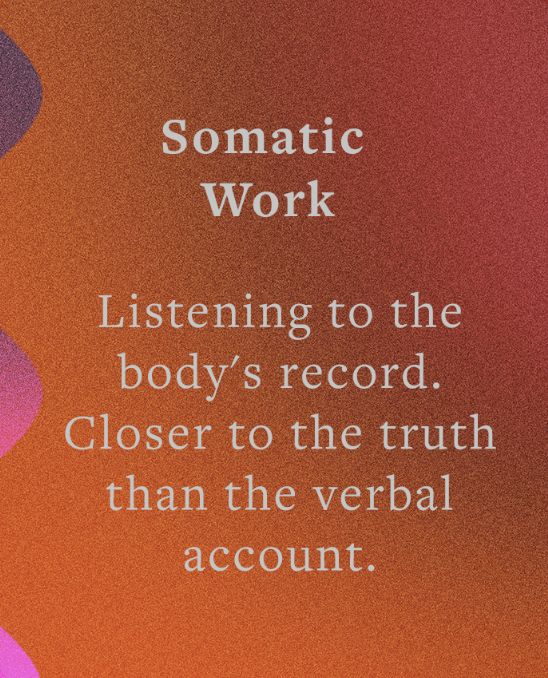
The hypnotherapy piece matters specifically here. The trance state and the ketamine state share territory — both involve heightened subconscious access, softened critical filtering, and direct contact with pre-verbal somatic material. Hypnotherapy gives integration sessions a specific tool for working in that space, not just talking about what happened but accessing and reshaping the patterns the medicine surfaced.
That combination — clinical license, hypnotherapy expertise, and direct experience with KAP patients — is rare. Most clinicians have one piece, occasionally two.
Who This Is For
Active KAP patients. You're in treatment with a clinic or prescriber and want integration support that's clinically sophisticated, individualized, and available beyond a 30-minute slot.
Post-journey clients. You had a powerful experience weeks or months ago. You felt opened. The insights have faded. The patterns are back. You want to figure out how to make it last — or whether to do another round, and how to do it differently.
Pre-treatment clients. You're considering KAP and want to make sure integration scaffolding is in place before you begin. The clients who get the most from ketamine almost always set this up first.
Other altered-state experiences. Psilocybin retreats, MDMA-assisted work, ayahuasca, an unplanned personal experience that asked something of you. The integration principles transfer; the work is shaped to what surfaced.

Inside The Work
WHAT THE RESEARCH SHOWS
Peer-reviewed research supports that integration extends ketamine’s effects, that the neuroplasticity window is real and time-limited, and that hypnotherapy is a particularly well-matched modality for this work. The studies below are drawn from PubMed, PMC, and clinical psychiatry journals. More research can be found on the research page.
-
Wilkinson et al., 2021—Psychotherapy and Psychosomatics · Yale School of Medicine
Patients with treatment-resistant depression received six IV ketamine infusions over three weeks. Those who achieved clinical response—defined as 50% or greater improvement in depression severity—were then randomized to either CBT or treatment as usual for an additional 14 weeks. The CBT group showed a moderate effect size advantage in sustained remission at the end of the study period (Cohen's d = 0.65). The authors explicitly identify ketamine's neuroplasticity window—the time-limited period following infusion during which synaptic reorganization occurs—as the biological rationale for why structured psychotherapy is more effective when delivered in sequence with ketamine rather than in isolation. A 2017 preliminary version of the same study by the same lead author produced consistent findings, establishing CBT as a viable strategy for extending ketamine's antidepressant effects without ongoing drug exposure.
→ 2021 RCT on PubMed · 2017 Preliminary Study on PubMed
-
Dore et al., 2019 — Journal of Psychoactive Drugs
The largest real-world outcomes study of ketamine-assisted psychotherapy to date, drawing on data from 235 patients across three clinical practices. Unlike infusion-only models—where ketamine’s psychedelic properties are treated as unwanted side effects to be minimized—all three practices in this study intentionally incorporated psychotherapy alongside ketamine administration, using the expanded state as a therapeutic resource rather than a pharmacological inconvenience. Findings showed meaningful reductions in depression, anxiety, and PTSD across the patient sample, with particularly strong results in older patients and those presenting with severe symptom burden. The authors conclude that KAP is an effective approach for a wide range of diagnoses in private practice settings—and that ketamine’s value extends well beyond the infusion room when paired with structured clinical support.
-
Adler & Scheib, 2020 — Journal of Psychedelic Psychiatry
The first published clinical case study of a structured Ketamine-Hypnosis Package (KHP)—combining ketamine infusion with hypnotherapeutic guidance and integration sessions. The clinical practice observed that patients who are poorly hypnotizable at baseline—including those with obsessive-compulsive presentations—became meaningfully more suggestible when ketamine and hypnotherapy were combined. Case data showed reductions in craving, improvement in treatment-resistant depression, and support for abstinence. The authors identify this as an understudied area with significant clinical potential.
-
Phelps, 2025 — The Journal of Clinical Psychiatry
Published February 2025. Clinical case report of a 71-year-old woman with a 20-year history of treatment-resistant depression. An indirect hypnotic suggestion introduced during a ketamine-expanded state prompted significant behavioral activation and contributed meaningfully to treatment response. The author—noting that research has established ketamine increases hypnotizability, but that no studies had yet formally explored the pairing—called hypnotherapy “an excellent modality to pair with ketamine” specifically because it can harness ketamine’s heightened suggestibility to facilitate behavior change. The author identifies this as an area worthy of further study.
-
Lemercier & Terhune, 2018 — Journal of Psychopharmacology
Foundational theoretical and empirical paper establishing the overlapping neurophenomenological features of psychedelic states and hypnosis. The authors propose that the two phenomena share mechanisms—including heightened subconscious access, softened critical filtering, and increased responsiveness to suggestion—and outline a research framework for coupling them at each stage of psychedelic-assisted therapy: preparation, the acute session, and integration. Conclusion: harnessing hypnotic suggestion during and after psychedelic experiences could meaningfully enhance therapeutic efficacy.
-
Patterson et al., 2018 — International Journal of Clinical and Experimental Hypnosis / PMC
University of Washington School of Medicine pilot study. Low-dose ketamine was administered to participants across hypnotizability ranges. In low-hypnotizable participants, ketamine produced a large-effect-size increase in hypnotic suggestibility scores (Cohen’s d = 1.57). The authors concluded this finding warrants further investigation into ketamine’s potential to enhance hypnotherapeutic outcomes—and that the dissociative, trance-adjacent state ketamine induces may be mechanistically related to hypnotic responsiveness.
-
Bhatt et al., 2021 — PubMed
Comprehensive review of preclinical and clinical evidence establishing neuroplasticity as a key downstream mechanism of ketamine’s therapeutic effects. Ketamine induces measurable synaptic and structural changes—including synaptogenesis and BDNF-mediated signaling—particularly in prefrontal cortical neurons. The authors describe these neuroplastic shifts as the mechanism through which sustained therapeutic change becomes possible, providing the biological rationale for timed integration work.
-
Calabrese & Bhatt, 2025 — Frontiers in Psychiatry
This paper makes a pointed argument directly relevant to how integration is timed and structured: meaningful, lasting improvement requires plasticity-driven reorganization in the days following ketamine administration—not primarily from insights during the acute session. The neuroplastic window begins after ketamine’s effects have fully subsided and lasts longer than the window produced by serotonergic psychedelics. Practitioners who overemphasize the acute experience risk distorting the process; those who time integration to the biological window are working with the medicine’s actual mechanism.
-
Joneborg I, Lee Y, Di Vincenzo JD, et al. Active mechanisms of ketamine-assisted psychotherapy: A systematic review. Journal of Affective Disorders. 2022;315:105–112.
A 2022 systematic review of five randomized trials of ketamine-assisted psychotherapy found significant positive effects on primary outcome measures versus controls; the authors propose that ketamine's temporary neural changes—NMDA receptor inhibition and increased synaptic neuroplasticity—create a window in which structured therapeutic work produces more durable change than the medicine alone. The review supports a now-foundational argument in the field: integration isn't adjunctive; it's how ketamine's effects become lasting.
programs
Single Integration Session
$375
90 minutes
For one-off experiences, post-journey check-ins, or testing fit. Includes a written summary of insights and integration next steps.
Integration Intensive
$2,250
six 90-minute sessions over 8–10 weeks
For active KAP patients or focused post-journey work. Sessions paced to your dosing schedule. Includes between-session voice memo access and a custom hypnotherapy recording tailored to your specific integration goals.
RECOMMENDED
Full Journey Program
$4,500
twelve sessions over 4–6 months
For patients who want comprehensive support across the full arc of treatment — preparation, integration aligned with your dosing schedule, and post-treatment stabilization. Includes everything in the Intensive, plus written integration materials, custom journaling prompts, and a final outcomes review with validated measures (PHQ-9, GAD-7, PCL-5 as clinically appropriate).
All packages prepaid. Sessions virtual via HIPAA-compliant video; limited in-person availability in downtown NYC. Monthly superbills sent automatically for out-of-network insurance reimbursement.

The trance state and the ketamine state share territory.
MEET Amanda, Your integration specialist

Licensed Mental Health Counselor (NY) with Diagnostic Privilege · Certified Clinical Hypnotherapist (CCHT) · NYU trained · In practice since 2018
The integration of clinical license, hypnotherapy expertise, and active experience working with KAP patients is the foundation of this work.
Asked & Answered
-
No. Pre-treatment preparation is some of the highest-leverage integration work. Clients who set up scaffolding before they begin almost always get more out of the medicine.
-
Yes. This work complements medical ketamine treatment, not replaces it. With your permission, I'll coordinate with your prescriber when useful.
-
No. Ketamine is administered by licensed medical providers, for which I can provide referrals to. I provide the psychotherapeutic integration that makes the treatment durable.
-
Monthly superbills are provided automatically for out-of-network reimbursement. Most PPO plans reimburse a meaningful portion of these rates after the OON deductible is met. I'll walk you through how to verify your specific benefits at intake.
-
The immediate- to 72-hour window after a dose is the highest-leverage period for integration work. Sessions are scheduled to align with your dosing whenever possible.
-
Yes—psilocybin retreats, MDMA-assisted work, ayahuasca, and other altered-state experiences. The integration principles are similar; the work is shaped to what surfaced.
-
Sessions are virtual via secure HIPAA-compliant video. Limited in-person availability in downtown NYC for clients who prefer that container.
LET IT LAND
Most of the value of ketamine therapy is in what happens between sessions, not during them. If you're ready to do that work — before, during, or after treatment — a free consultation is the right next step.